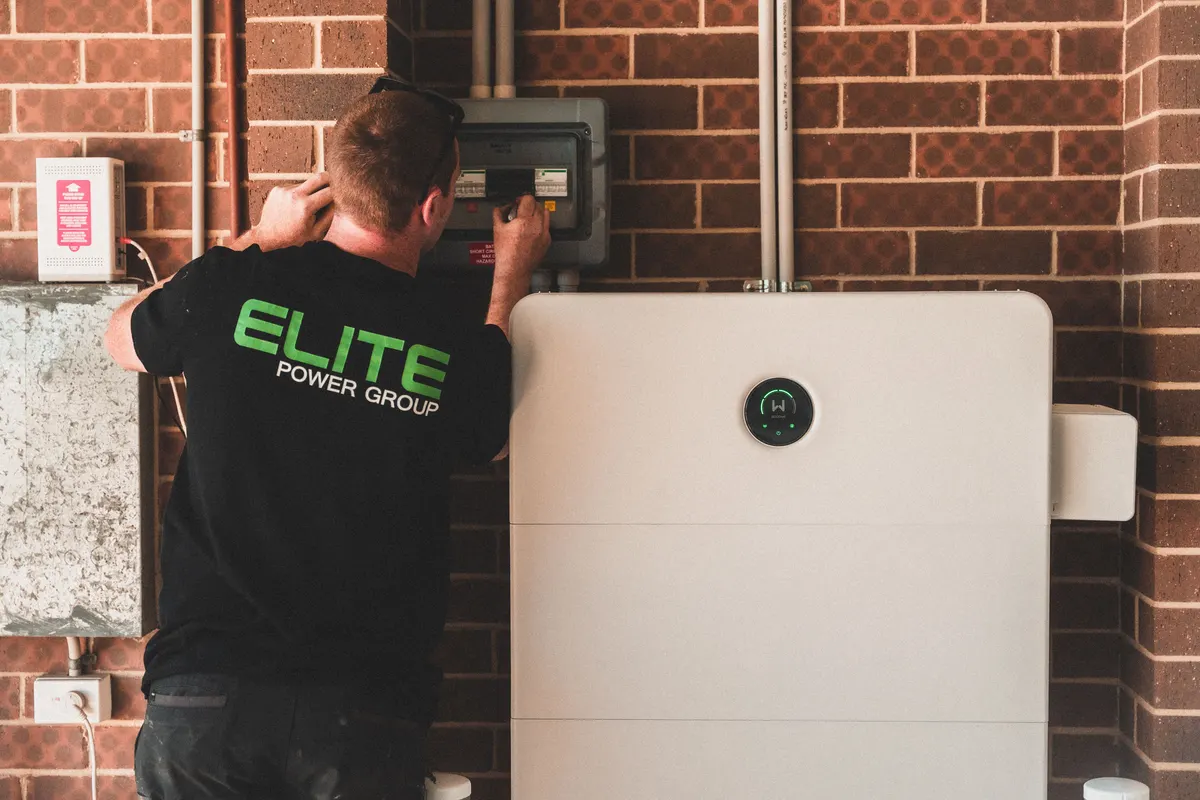
The FranklinWH aPower 2 is a 15 kWh home battery. It can run most of a house for several hours. There is no engine, no fuel tank, and no carbon monoxide risk. A single unit installed in a North Shore home runs about $17,000 to $18,000 before any rebate. Pair it with solar, and ComEd will send back up to $4,500 of that. It is a strong fit for quiet backup, EV charging, and shorter outages in Wilmette, Winnetka, or Glenview. Most North Shore homes still need a natural gas generator, a second battery, or both to get through a multi-day ComEd outage.
What Is the FranklinWH aPower 2?
The aPower 2 is FranklinWH's second generation home battery. It stores 15 kWh of usable energy and puts out 10 kW of continuous power. It can start loads as large as a 5 ton air conditioner on its own. Up to 15 units can stack together on one aGate controller for 225 kWh of total storage. The system carries a 15 year warranty rated to 60 MWh of total throughput, one of the longest in the category.
Inside the cabinet is lithium iron phosphate, or LFP, battery chemistry. It runs cooler and handles more charge cycles than the older chemistries used in some competing batteries. The aGate controller is the brains of the system. It shifts power between solar, the battery, and the grid automatically, based on rules you set. You are not manually flipping switches during an outage. FranklinWH also builds the aPower 2 with fan less convection cooling. That makes it quieter than battery systems that rely on a fan to stay cool.
FranklinWH is not a generator. It stores power rather than making it. That is why FranklinWH installation on the North Shore usually comes up alongside a standby generator conversation, not instead of one.
How Much Does FranklinWH Cost Installed in Illinois?
A single aPower 2 typically costs $17,000 to $18,000 installed in Illinois before any rebate, based on real 2026 marketplace quotes tracked by EnergySage. Some homes want enough backup to cover a bigger slice of the house, or to stretch an outage past a day. Those homeowners often add a second unit for a combined cost around $35,000.
| Configuration | Usable Capacity | Typical Installed Cost | ComEd Rebate* |
|---|---|---|---|
| 1 aPower 2 | 15 kWh | $17,000 to $18,000 | $4,500 |
| 2 aPower 2 | 30 kWh | Around $35,000 | $9,000 |
*Rebate shown assumes the system qualifies under ComEd's current solar pairing rule. See the rebate section below.
That price point is higher per kWh than most natural gas standby generators cost for whole house coverage. A full whole house generator installation on the North Shore typically runs $8,000 to $18,000 depending on home size. That unit can run for as long as the gas keeps flowing, not just for a day on stored charge. The tradeoff is silence and simplicity versus unlimited runtime, and that is the real decision North Shore homeowners are weighing.
Not Sure If a Battery, a Generator, or Both Fit Your Home?
Tell us about your house and your outage history and get a free, no obligation installation estimate from one licensed local electrician partner.
Get a Free EstimateIs FranklinWH Better Than a Standby Generator for the North Shore?
Neither option wins on every point. A battery runs silently and needs almost no maintenance. But its runtime is capped by how much energy it holds. A standby generator refuels itself from a natural gas line. It can run for as long as the outage lasts. That matters most when storms knock out power for days, not hours, like the ones that cut service to more than 122,000 ComEd customers across the July 2026 Chicago storms.
| Factor | FranklinWH aPower 2 | Standby Generator |
|---|---|---|
| Runtime | About a day per unit under moderate use | Unlimited while gas keeps flowing |
| Noise | Silent, no moving parts | 60 to 70 decibels while running |
| Power restoration | Instant, no transfer delay | 10 to 30 seconds after an outage starts |
| Fuel source | None, charges from the grid or solar | Natural gas or propane |
| Typical installed cost | $17,000 to $18,000 per unit | $8,000 to $18,000 whole house |
| Maintenance | Minimal, no oil or filters | Annual service plus a weekly self-test |
Many North Shore homes end up choosing both. A generator covers the whole house for as long as an outage lasts. A battery adds instant, silent power for the seconds before a generator's automatic transfer switch kicks in, plus daytime backup for solar owners. Why the North Shore loses power so often comes down to tree canopy and aging overhead lines. Neither a battery nor a generator fixes that problem on its own. But either one keeps your home running while ComEd crews do their work.
How Does FranklinWH Hold Up in a Chicago Winter?
FranklinWH's own support documentation lists an operating range of -4°F to 122°F for its home power system. Output eases back between 113°F and 122°F, and the recommended comfort zone is 32°F to 86°F. Chicago's coldest day on record hit -27°F on January 20, 1985. A hard polar vortex can still push air temperatures to -10°F or colder across the North Shore. A battery sitting in an unheated garage on one of those nights is closer to the edge of its rated range than most homeowners realize.
A standby generator, by contrast, is built for exactly this. With a cold weather kit, most standby units are rated to start reliably down to about -20°F, well past where a battery starts to struggle. If you are leaning on FranklinWH as your main backup plan, keep it in a conditioned space when possible, such as a heated garage or basement mechanical room. See our winterizing guide for the same cold weather prep that applies to standby equipment.
Do You Get a Rebate or Tax Credit for FranklinWH in Illinois?
Yes, but the rules changed recently, and the answer depends on whether you also install solar. ComEd pays $300 per kWh of battery capacity through December 31, 2029, dropping to $250 per kWh starting January 1, 2030. That is $4,500 back on one 15 kWh aPower 2, or $9,000 on two units. ComEd caps the payment at 5 kWh of storage for every 1 kW of battery power, with a 25,000 kWh total ceiling. A single home battery install will not come close to reaching that limit.
Until now, that rebate required pairing the battery with qualifying solar interconnected after August 11, 2022. It also required five years of enrollment in ComEd's Scheduled Dispatch Virtual Power Plant, which dispatches stored power from 4 to 6 p.m. on summer weekdays. A revised ComEd tariff effective October 19, 2026 adds a stand-alone battery rebate for systems with no solar attached. ComEd will not begin accepting those applications until January 1, 2027, and only for batteries connected to the grid after June 1, 2026. If you are installing FranklinWH without solar this fall, plan on applying once that window opens rather than at the time of installation.
On the federal side, the Section 25D battery storage tax credit ended for anything placed in service after December 31, 2025. A cash or loan purchase in 2026 gets no federal credit. Leasing a battery can route around that limit. The Section 48E credit lets the company that owns the equipment claim it instead, though any savings passed back to you as a lower lease payment are not guaranteed. Rewiring America's incentive tracker is a good place to confirm current federal status before you sign a contract.
FranklinWH vs. Tesla Powerwall 3: Which Should You Choose?
FranklinWH is not the only whole home battery option. The honest answer is that each one fits a different budget. A single Tesla Powerwall 3 runs about $13,473 installed, a cheaper entry point than one aPower 2. The Powerwall 3 is also DC coupled, a slightly more efficient design than FranklinWH's AC coupled approach. It involves fewer power conversion steps.
Where FranklinWH pulls ahead is at whole home scale and in warranty length. Two aPower 2 units reach a meaningful chunk of whole home backup for around $35,000. Three Powerwall 3 units, needed to reach similar storage, run about $40,400, based on 2026 marketplace pricing. FranklinWH's 15 year warranty also runs longer than most competing batteries. Its 10 kW continuous output edges out many rivals for starting large loads like central air or a well pump. If your budget starts small, Powerwall is the easier entry. If you are planning for true whole home coverage, FranklinWH often ends up the better value per kWh.
The right call for your North Shore home depends on how long your outages usually run. It also depends on whether silent, fuel free backup or unlimited runtime matters more to your family. A local electrician partner can walk your electrical panel and review your outage history. They can size a FranklinWH system, a standby generator, or a combination of both, so you are not guessing. Reach out for a free, no obligation estimate below.
Frequently Asked Questions
How long will a FranklinWH aPower 2 battery run my house?
One 15 kWh aPower 2 can power most essential circuits in a North Shore home for about a day under moderate use. Expect less time if you are running central air conditioning or an electric range. For whole house coverage through a multi-day outage, most homeowners pair it with a second battery, solar, or a natural gas standby generator.
Does FranklinWH work in cold weather?
FranklinWH rates its home power system to operate from -4°F to 122°F. Output eases back between 113°F and 122°F, with a recommended range of 32°F to 86°F. Chicago's record low is -27°F, set on January 20, 1985. On the coldest nights, a battery kept in an unconditioned garage can approach the edge of its rated range.
How much does FranklinWH cost installed in Illinois?
A single 15 kWh aPower 2 typically runs $17,000 to $18,000 installed before incentives, based on 2026 marketplace pricing. Two units for more backup capacity run around $35,000 before incentives.
Is there still a rebate for a home battery in Illinois in 2026?
Yes. ComEd pays $300 per kWh of battery capacity through December 31, 2029, which is $4,500 on one 15 kWh aPower 2. That rebate currently requires pairing the battery with qualifying solar and five years in ComEd's Scheduled Dispatch Virtual Power Plant. A stand alone battery rebate for systems without solar opens for applications on January 1, 2027.
Can I still get a federal tax credit for a home battery in 2026?
Not for an outright purchase. The Section 25D credit ended for systems placed in service after December 31, 2025. Leasing a battery may indirectly qualify through the Section 48E credit, which the leasing company claims, not the homeowner.
Is FranklinWH better than a Generac or Briggs and Stratton standby generator?
Neither is strictly better. FranklinWH runs silently with no fuel and no moving parts, but its runtime is limited by battery capacity. A standby generator refuels from natural gas and can run indefinitely. That still matters most for North Shore homes expecting multi-day outages from storms and winter weather.