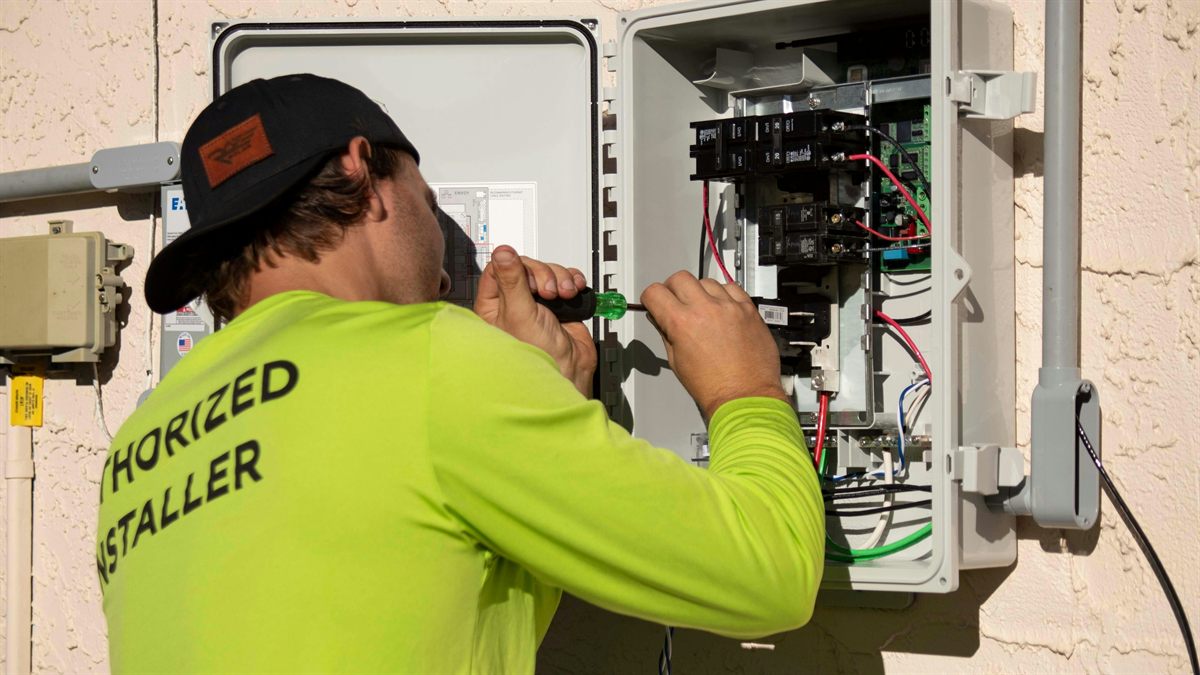
A whole house generator burns natural gas and can run for as long as your gas line supplies it, days or even weeks. A home battery stores a fixed amount of power, usually 15 to 30 kWh, and runs out unless the sun or the grid recharges it. For most North Shore homes with sump pumps, finished basements, and multi-day ComEd outages, that difference is the whole decision.
Both options connect to your home's electrical panel and both can carry a full house through an outage. The right pick depends on how long your power tends to stay out, what you need to keep running, and how much you want to spend up front.
The Real Difference Between a Generator and a Battery
A standby generator is an engine. It sits outside on a pad, connects to your home's natural gas line, and starts itself within seconds of a power loss. A home battery, like FranklinWH's aPower 2, is a sealed box of stored energy, usually mounted in a garage or basement. It has no engine, no fuel, and no moving parts. It switches on silently and draws down its stored charge until it's empty or recharged.
Both connect through a transfer switch so your home's wiring pulls from the backup source instead of the grid. A generator can also pair with solar and a battery in the same system, which is where the "can you have both" question below comes in.
How Long Each One Actually Lasts
A natural gas generator has no real runtime limit. As long as Nicor or North Shore Gas keeps delivering gas to your meter, the unit keeps running. A home battery has a hard limit set by its capacity. A single 15 kWh unit covers a typical home's essentials, refrigerator, sump pump, some lights and outlets, for roughly a day of moderate use. Stack a second unit and you're closer to two days. Beyond that, without solar panels feeding it, the battery just goes flat.
This matters most for the outages that actually hit the North Shore. The tree canopy and aging overhead lines behind frequent ComEd outages tend to produce multi-day restoration windows after a bad storm, not quick one-hour blips. In July 2026, ComEd storms knocked out power to hundreds of thousands of customers across the region, with full restoration stretching over several days in the hardest-hit towns.
| Factor | Standby Generator | Home Battery |
|---|---|---|
| Runtime | Unlimited (tied to gas supply) | Fixed, typically 15 to 60 kWh |
| Typical whole-home coverage | Full house, days at a time | Essentials only, unless oversized or paired with solar |
| Start time after outage | 10 to 30 seconds | Instant, no gap in power |
| Refuels itself | Yes, natural gas line | Only with solar or grid power to recharge |
| Fuel storage needed | None (natural gas) or propane tank | None |
What Each One Costs in Illinois
A whole house generator sized for a typical 2,500 to 4,000 square foot North Shore home runs $8,000 to $18,000 installed, covering the unit, transfer switch, gas line, pad, and permits. A Briggs & Stratton PowerProtect unit alone typically costs $4,000 to $9,000 depending on size, from a 13 kW model up to a 26 kW model for larger homes.
A home battery system costs more per unit of backup power. A single FranklinWH aPower 2 (15 kWh) installed typically runs $12,000 to $16,000. Homeowners who want two days of coverage often need two units, pushing the total closer to $20,000 to $28,000, before any rebate. For a closer look at FranklinWH pricing, specs, and how it performs in a Chicago winter, read our full FranklinWH battery review.
| Standby Generator | Home Battery | |
|---|---|---|
| Typical installed cost | $8,000 to $18,000 | $12,000 to $28,000 |
| Cost per hour of backup | Pennies (natural gas rate) | None once charge is used, unless recharged |
| Annual maintenance | $150 to $350 service plan | Minimal, no engine to service |
Not Sure Which Backup Option Fits Your Home?
Tell us about your home and how long your outages usually last. We'll route your request to one local, licensed electrician who installs both.
Get a Free EstimateRebates and Incentives That Actually Apply
Illinois offers a real financial incentive for battery storage that generators don't qualify for. ComEd's Distributed Generation rebate pays $300 per kWh of installed battery storage capacity, credited after installation. A single 15 kWh aPower 2 unit could qualify for around $4,500 back. As of 2026, that storage rebate no longer requires you to also install solar, following changes passed in late 2025.
What's gone is the federal side. The federal residential clean energy credit under Section 25D, which used to cover 30% of battery and solar costs, ended for any system placed in service after December 31, 2025, under the One Big Beautiful Bill Act. If you're pricing a battery system in 2026, that 30% federal credit is no longer available for a cash or loan purchase. Some leased or PPA-financed systems can still route through a commercial credit, but that's a narrower path and worth confirming with your installer before assuming it applies.
Generators don't carry a special Illinois rebate, but they also don't carry the price tag a battery does, so the math still tends to favor the generator for homeowners chasing whole-home coverage on a budget.
Noise, Fumes, and Safety
A standby generator runs at roughly 60 to 70 decibels, about like a normal conversation from a few feet away, and it produces exhaust like any combustion engine. That's why placement rules exist. Illinois villages require generators to sit a minimum distance from windows, doors, and property lines, and permits and inspections confirm that clearance before the unit goes live. A battery makes no exhaust and almost no sound, since it has no engine.
Neither system is dangerous when installed correctly. The real risk with any backup power source is a bad transfer switch or a homeowner trying to backfeed the panel without one, which can send power back into supposedly dead lines and injure utility crews. That's the same reason portable generators carry more day-to-day risk than standby units, they rely on the homeowner to run cords and manage fuel correctly every single time.
Which One Fits Your North Shore Home
If your outages typically run more than a few hours, and especially if you've got a sump pump, a finished basement, or medical equipment that needs power around the clock, a natural gas generator is the safer bet. It doesn't run out. Homes in Wilmette, Evanston, and other older North Shore towns with combined sewer systems lean this direction for exactly that reason. For a smaller, cheaper first line of defense just for the pump itself, see our sump pump battery backup vs. generator comparison.
If your outages are usually short, if you already have or are adding solar panels, or if you specifically want silent, fume-free backup and are willing to pay more for it, a battery system like FranklinWH makes sense. It also works well as a second layer for homeowners who already have a generator and want quiet backup for a few key circuits without starting the engine for a five-minute blip.
Can You Have Both
Yes, and more North Shore homeowners are asking about it. A generator handles the multi-day storm. A battery, especially one paired with solar, can absorb the short outages and daily grid hiccups without the generator ever needing to start. The two systems can share a transfer switch setup so the battery covers the first stretch of an outage and the generator kicks in automatically if the outage runs long. It costs more than either system alone, but it's the closest thing to outage-proof a home can get.
Frequently Asked Questions
Is a battery backup as powerful as a whole house generator?
A single home battery can power a whole house, but only for a limited time, usually about a day per 15 kWh unit under moderate use. A natural gas generator can power a whole house indefinitely as long as the gas keeps flowing.
How much does a FranklinWH battery cost installed in Illinois?
A single FranklinWH aPower 2 (15 kWh) typically costs $12,000 to $16,000 installed. Homes that want two days of backup often need two units, closer to $20,000 to $28,000 before rebates.
Do I still get a tax credit for a home battery in 2026?
No federal credit applies to a cash or loan purchase placed in service in 2026. The federal Section 25D credit ended after December 31, 2025. Illinois' ComEd Distributed Generation rebate of $300 per kWh still applies and does not require solar.
Can a battery run my sump pump during a multi-day outage?
A single battery can run a sump pump for a day or so under normal conditions, but a multi-day North Shore storm outage can outlast that charge unless the battery is paired with solar or a generator as backup.
Is a generator or a battery quieter?
A battery is silent since it has no engine. A standby generator runs at roughly 60 to 70 decibels while operating, similar to a normal conversation.
Do I need a permit for a home battery like I do for a generator?
Most North Shore villages require an electrical permit for a home battery installation, though it's typically a lighter process than the combined electrical and gas permit a generator needs. Confirm the specific requirement with your village before scheduling installation.
Whichever direction fits your home, the fastest way to get real numbers is a site assessment. Tell us your home size, your typical outage length, and what you need to keep running, and we'll connect you with one local, licensed electrician who installs both generators and battery systems. Get your free estimate here.